

The Colonial Capital of Delaware
Under William Penn and His Family
When William Penn arrived in North America in 1682, he first stepped ashore at New Castle. Soon after, the town became the political center of the southernmost counties of Pennsylvania – known as the “Three Lower Counties on Delaware” - what we now call the State of Delaware.
The Three Lower Counties were geographically, economically and politically different than the rest of Pennsylvania. This made governing them with a single assembly based in Pennsylvania very difficult.
In 1704, William Penn granted the Three Lower Counties their own assembly, though they remained under his control. The colonial assembly met at the New Castle Court House.
Following a serious illness that left William Penn unable to govern, his wife Hannah became the acting proprietor of Pennsylvania. She continued to govern after his death in 1718. After her death in 1726, the colony was governed by the couple’s sons, John, Richard and Thomas, then by their grandsons, John and Richard.
The Penn family’s proprietorship ended in 1776 with declarations of separation and independence.


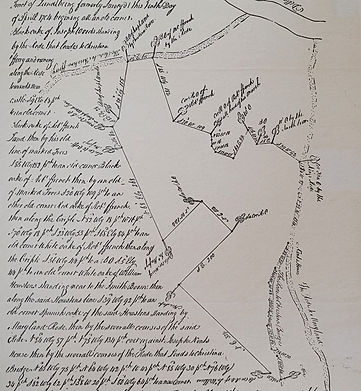
Dakeyne [sic] Survey of New Castle Common, 1704
The New Castle Common:
A Private Trust for the Public Good
Long ago in Europe, many towns had a "Common": land that belonged to everyone in the village. New Castle residents used common land to pasture livestock and cut wood starting in the 1600s. In 1701, William Penn honored this tradition by setting aside 1,068 acres of land just for the people of New Castle. Over time, nearby farmers started to use the land to make money. To prevent this, in 1761 Penn’s sons created a group called the Trustees of the New Castle Common. Their job was to manage the land and make sure it stayed “common” for the whole town.
The New Castle Common still exists today, but it looks a lot different now. It's smaller and, instead of fields for cows, it now has shopping centers and offices.
The Trustees of the New Castle Common still manage it. They use the money earned from those buildings to help the people of New Castle in many ways, including supporting New Castle Historical Society, paying for the public library and firehouse, and caring for parks and open green spaces