


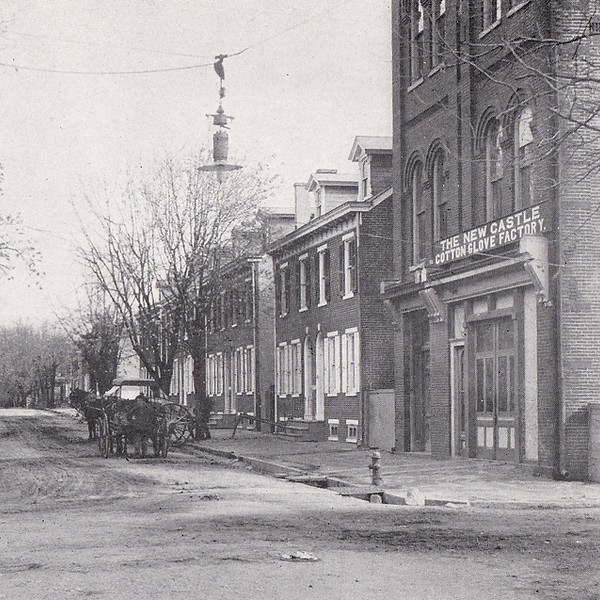
New Castle Cotton Glove Factory on West 5th Street, circa 1900.
Collection of New Castle Historical Society.
Tasker Iron Works near Dobbinsville in New Castle. Engraving, 1872.
Collection of the New Castle Historical Society.
A Small Industrial Town
in the Early 20th Century
By the mid-1800s, New Castle was no longer a travel hub, so it reinvented itself as a factory town. It was soon filled with big factories making flour, clothes, umbrellas, gloves, and even giant steam engines.
In 1928, Giuseppe Bellanca opened an airplane factory and airfield in New Castle. His team built over 3,000 planes. They were famous for being well-designed and efficient.
The people who worked in the factories needed houses, so small neighborhoods of rowhouses were built throughout New Castle. The town became a place that you never had to leave to get what you needed. It had its own butchers, bakers, doctors, grocers, and even jewelry stores.
Eventually, the factories began to close down. People started using cars to drive to bigger cities, like Wilmington, for work. Instead of shopping at the small stores in downtown New Castle, people drove to big malls and supermarkets.
Because people stopped working and shopping in the center of town, New Castle turned into a "bedroom community." That means it has become a quiet place where people mostly live and sleep, while they go somewhere else for work and fun.
Once Again an Important Transportation Link
in the Early 20th Century
When automobiles became popular and affordable in the early 1900s, people all across America began to travel more. But for people who wanted to drive from Delaware to New Jersey, there were no bridges across the Delaware River.
In 1925, the White Line automobile ferry service opened at the end of Delaware Street. Within a year, the Wilson Line opened a competing ferry service a block north at Chestnut Street. The two lines merged in 1927. The Delaware – New Jersey Ferry Company operated hourly ferry service (6 am to midnight) between New Castle and Pennsville, New Jersey.
The ferries brought thousands of travelers through New Castle. Restaurants and other businesses sprang up to serve travelers waiting for the ferries.
The ferries closed in 1951 when the Delaware Memorial Bridge made them obsolete. Once again, New Castle became a quiet town.
 |  |  |  |
|---|---|---|---|
 |

Fishing on the Delaware River:
From Caviar Craze to Cleaner Waters
For hundreds of years, fishing for shad and sturgeon was an important way to make money in New Castle. Early Dutch settlers nicknamed these fish “silverbacks.”
Every spring, fishermen would hop into small boats called "shad skiffs," and drag giant nets through the river. At the end of a long day, they’d hang those heavy nets out to dry on the riverbank where Battery Park is today.
Fishing was so profitable that factory workers would take time off from their regular jobs between March and May just to fish.
Because there were no refrigerators, workers packed the fish into wooden chests filled with ice. During the busiest part of the season, two full train cars packed with fish were shipped out of New Castle every day.
But by the 1920s, the "glory days" of fishing were over. Big factories had moved in along the river, and their water pollution made it hard for fish to survive. In addition, people caught too many fish too fast – faster than fish could reproduce and grow. Sturgeon were hit the hardest because everyone wanted their eggs (called caviar), which was a fancy and expensive food trend at the time.
Today, the Delaware River is much cleaner. Shad have returned and are doing well. But Atlantic Sturgeon are still endangered, meaning there are very few left. Because they are so rare, it is against the law to fish for sturgeon in Delaware today.
Did you know? There were once so many fish in the Delaware River that people said you could walk across the river on their backs!
 |  |  |  |
|---|
Giuseppe Bellanca:
The Man Who Built the Future of Flight
In 1927, the du Pont family convinced Giuseppe Mario Bellanca, a world-famous airplane designer from Sicily, to start an aircraft company in New Castle.
Bellanca’s planes weren’t just fast; they were famous for being safe, reliable, and able to travel long distances.
One of Bellanca’s most famous achievements was in 1931. His plane called Miss Veedol made history by becoming the first plane ever to fly across the Pacific Ocean without stopping once. The trip took 41 hours - almost two full days!
Before Bellanca, flying long distances was extremely dangerous. His innovative designs proved that planes could travel safely across the world. He paved the way for the international flights we take every day.
Because he changed the world of flying forever, Giuseppe Bellanca was inducted into the National Aviation Hall of Fame in 1973.
Did You Know? Famous aviator Charles Lindburgh asked Bellanca to provide the plane for his famous flight across the Atlantic. Bellanca said yes…but only if one of his own employees was the pilot. That ended the conversation!
 |  |  |  |
|---|